
Wall protection used to mean a choice between beige, grey and a woodgrain. Printed wall protection changes that. Manufacturers now print photographs, illustrations, patterns and wayfinding graphics into impact-resistant rigid sheet, so a corridor wall can be both durable and part of the interior design. This article explains how these products work, where they are typically used, how the design and approval process runs, and what to plan for at installation.
What printed wall protection is
Printed wall protection is rigid sheet wall covering with a digital image built into it. The sheet does the same job as standard wall protection, resisting scuffs and impacts from carts, beds and chairs, while carrying a custom graphic that would not survive long as paint or vinyl wallpaper in a busy corridor.
Construction Specialties: Acrovyn by Design
C/S calls its product Acrovyn by Design. Based on the manufacturer’s published data sheet, the graphic is digitally printed on the back of a clear Acrovyn sheet and sealed with a protective backing, so the image sits behind the sheet rather than on its face. The sheet is a PVC-free material, listed at a nominal 0.040 in. thickness, and offered in standard 4 ft x 8 ft and 4 ft x 10 ft sizes. C/S publishes a Class A fire rating for the product; check the current data sheet for the exact values that apply to your project.
C/S also offers the same printing on doors (Acrovyn Doors by Design), so a door can continue a mural instead of interrupting it. For imagery, designers can supply their own artwork with copyright clearance, choose from C/S pattern collections, or work with the manufacturer’s design support. C/S also notes a partnership with Getty Images and iStock for sourcing stock photography.
Inpro: Aspex printed wall protection
Inpro’s equivalent is Aspex printed wall protection, listed within its rigid sheet family. Inpro describes it as high-resolution custom printing on a durable wall protection substrate, intended to carry artwork, imagery and messaging. Material, fire rating and sheet size details should be confirmed on Inpro’s current Aspex data sheet and installation instructions, as they can differ from the C/S product.
Where it is used
Printed panels make the most sense where walls take abuse and the space also benefits from colour, imagery or direction. Typical applications include:
- Pediatric and children’s hospital areas – murals and playful graphics that help make clinical spaces less intimidating.
- Long-term care and retirement homes – colour-coded corridors, landmark images and wayfinding cues that help residents recognise where they are.
- Schools and child care centres – school colours, logos and themed walls in hallways that see constant traffic.
- Lobbies, libraries and corporate spaces – branded feature walls that still stand up to daily wear.
- Elevator lobbies and service corridors – where carts and equipment would quickly damage painted graphics.
For wayfinding, coordinate early with the signage consultant. Graphics on wall protection support wayfinding, but they do not replace the code-required or accessible signage that belongs in Division 10 signage sections.
Design and approval workflow
Printed wall protection adds a design approval step that standard sheet goods do not have. On most projects the sequence looks roughly like this:
- Concept – the designer selects imagery or a pattern and identifies which walls receive printed panels.
- Field verify – actual wall dimensions, outlets, switches, thermostats, door frames and window openings are measured on site. A graphic built from drawing dimensions alone can land badly once real conditions are known.
- Panel layout – the image is divided into sheets, with seams placed where they least disturb faces, text or key details.
- Digital proofs – the manufacturer issues proofs showing the image on each panel, with seams and cutouts marked. The designer and owner review and sign off.
- Production and delivery – printing starts only after approval, so this item needs a realistic place in the schedule.
- Installation and closeout – panels are installed in sequence, protected, and documented with care and maintenance instructions for the owner.
Image quality is the most common issue. Low-resolution files that look fine on screen can appear soft when enlarged to wall scale. Both manufacturers publish artwork guidance, and C/S provides a graphics guide covering image setup, pricing structure and timeline. Ask for those documents before the design is finalized, not after.
Installation considerations
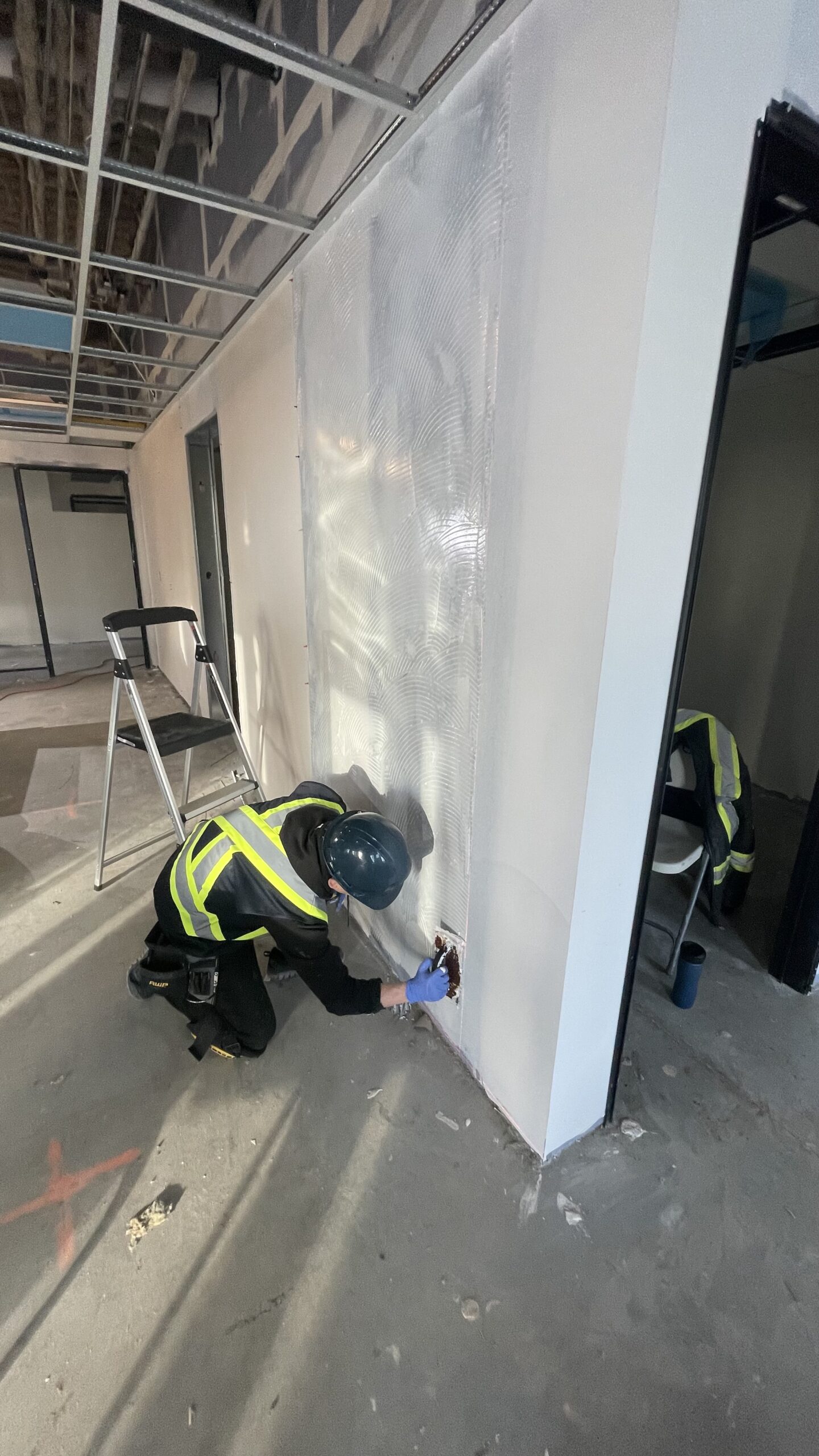
Printed panels install much like standard rigid sheet, but mistakes are harder to hide. A solid-colour sheet that gets damaged can be swapped from stock; a printed panel is a one-off that must be reprinted. Points we pay attention to include:
- Panel numbering – each sheet belongs in exactly one location. Check the panel map against the delivery before starting.
- Substrate prep – flat, clean, primed walls give the adhesive a proper bond and keep the image looking even.
- Adhesive and curing – use the manufacturer’s approved adhesive. The C/S data sheet calls for a controlled room temperature range for a period after installation, so coordinate with HVAC start-up.
- Cutouts – openings for devices are cut on site. Measure twice; a wrong cut means a new printed panel and a delay.
- Trims and seams – confirm whether the design uses visible trims, clear caulk joints or another detail, and show it on the shop drawings.
- Protection until closeout – cover finished walls while other trades complete their work.
Ordering a small number of spare panels for high-risk areas is worth discussing with the owner, given the lead time to reprint.
Related project experience
GRIT is an authorized Acrovyn installer and has installed Acrovyn sheet goods in care settings across Ontario. At the Halton Centre for Child Care, for example, we installed full-height 4×8 Acrovyn sheets with no middle trims and precise window cutouts. Full-height, seam-sensitive layouts like that call for the same careful field measurement and layout planning that printed panels require.
Planning printed wall protection in Ontario?
GRIT Construction Services supplies and installs wall protection, including Acrovyn sheet products, corner guards, crash rails and handrails, for hospitals, long-term care homes, schools and commercial buildings across the GTA. We install to the specified product and can help with field measurements and shop drawings. Send us your drawings for a quote, usually within 48 hours. Visit our wall and corner protection page, browse our projects, or contact us at (647) 382-8256 or info@gritcon.ca.
Sources: C/S – Acrovyn by Design Custom Graphics; C/S Wall Protection FAQs; Inpro – Aspex Printed Wall Protection; Inpro – Door + Wall Protection.