
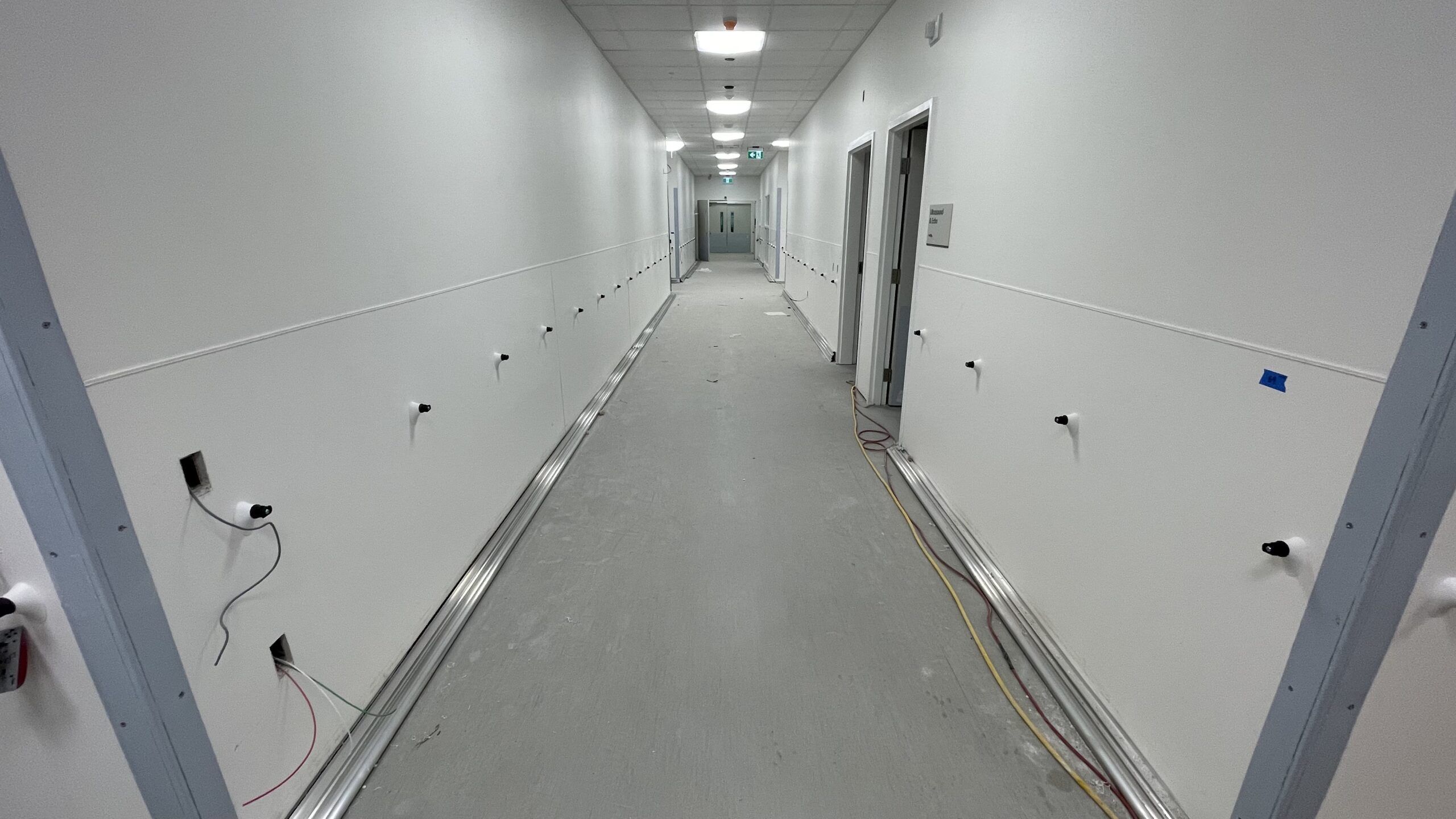
If you have estimated or built a hospital, long-term care home or school in Ontario, you have almost certainly seen a Division 10 wall protection section name either Construction Specialties (C/S) or Inpro as the basis of design. These two manufacturers cover most of the same ground: rigid sheet wall covering, corner guards, crash or bumper rails, handrails and door protection. This article gives a neutral overview of each product family, how specs usually treat them, and what an installer looks at before ordering material.
A quick note on where we stand: GRIT Construction Services is an authorized Acrovyn installer, but we install whatever the drawings and specifications call for. The goal here is to help general contractors, estimators, designers and facility managers compare apples to apples.
Construction Specialties: the Acrovyn family
C/S sells its wall protection under the Acrovyn name. According to the manufacturer, current Acrovyn material is an engineered PETG that is free of PVC, phthalates, BPA and persistent bioaccumulative toxins. C/S also offers a version with post-consumer recycled content, and publishes UL-classified Class A fire ratings for many of its profiles and wall coverings. As always, confirm the exact rating for the specific product and thickness on the current data sheet.
The main Acrovyn wall protection groups are:
- Wall coverings and panels – rigid sheet supplied in standard sheet sizes, in solid colours, woodgrains and custom printed imagery (Acrovyn by Design).
- Corner guards – surface-mounted and flush-mounted profiles in Acrovyn and metal finishes.
- Crash rails and handrails – from slim decorative rails to robust impact rails, plus heavy-duty stainless steel and rubber crash rails intended for back-of-house and loading areas.
- Door and frame protection – including products C/S lists for use on certain fire-rated door assemblies.
- Dimensional mouldings and accessories – trims, end caps and transitions.
For wall panels, C/S describes three mounting approaches: its demountable Sure Snap system, a French cleat option for tight clearances, and permanent adhesive. That choice matters on site, because it changes substrate prep, layout and how damaged panels get replaced years later.
Inpro: rigid sheet, guards and rails
Inpro (based in Wisconsin) organizes its door and wall protection into a similar set of families. Its published product lines include:
- Rigid sheet – Palladium rigid sheet with matching trims, plus Aspex printed wall protection and other specialty wall systems.
- Corner guards – several numbered series in surface-mount and flush-mount styles, tape-on guards, fire-rated options and stainless steel.
- Wall guards (bumper or crash rails) – multiple numbered series, including stainless steel.
- Handrails – several handrail series, including a lighted option.
- Chair rail, wall base, and headboard/bed locator products for patient rooms.
Inpro’s published guide specification lists high-impact vinyl products alongside a PVC-free option, G2 BioBlend, which is described as a PETG material. In other words, both manufacturers now offer a PETG-based route, and Inpro still offers vinyl. If PVC-free is a project requirement (common on projects pursuing sustainability targets), make sure the spec says so clearly rather than relying on the brand name alone.
How specifications usually name these products
Most Ontario wall protection sections (MasterFormat 10 26 00) follow a familiar pattern. The architect selects one manufacturer as the basis of design, lists model or series references, and then either names one or more approved equals or allows substitution requests under Division 01. Sometimes the section says substitutions are not permitted, which usually means the owner has a standard across its facilities.
When a spec allows an alternate, the burden is on the contractor to show equivalence. In practice that means matching:
- Material type (vinyl vs. PVC-free PETG) and nominal thickness
- Fire performance tested to CAN/ULC-S102 for Canadian projects, not just the US ASTM E84 result
- Profile size, return depth and impact performance
- Colour and texture, which the designer will usually want to see as physical samples
- Fire-rated door and frame compatibility where protection goes on rated openings
Equivalence is rarely exact. Colour palettes differ, profile dimensions differ slightly, and trims do not interchange between brands. Submitting an alternate late in the job can slow approvals, so raise it at tender or early in the submittal schedule.
What installers look at before ordering
Whichever manufacturer is specified, the installation questions are much the same. Before we release an order we usually check:
- Field-verified dimensions – wall lengths, ceiling heights, corner heights and opening locations rarely match the drawings exactly.
- Substrate – drywall finish level, primer and flatness all affect adhesive bond. Glossy paint or uneven taping shows through sheet goods.
- Blocking – handrails and crash rails need solid backing at bracket locations, which has to be in the wall before board goes up.
- Mounting heights – handrail and rail heights should be confirmed against the drawings and any accessibility requirements before brackets are laid out.
- Sequencing – sheet goods and rails go on after paint but before final fixtures, and need protection from other trades until closeout.
- Adhesive and conditions – each manufacturer specifies its own adhesive and temperature range; follow the current installation instructions rather than habit.
Shop drawings matter more than people expect. A clear elevation showing sheet layout, seam locations, trim types and cutouts saves arguments later, especially on full-height walls.
A recent example
At the Halton Centre for Child Care, GRIT installed full-height 4×8 Acrovyn sheets with no middle trims and precise cutouts around windows. On jobs like that, the layout and shop drawing stage did most of the work: seams had to land in the right places and every cutout had to be measured on site before cutting. The same process applies whether the spec names C/S, Inpro or another approved product.
Choosing between them
For most owners and designers, the choice comes down to existing facility standards, colour and finish selection, PVC-free requirements, budget, and local availability. Both companies make complete systems, and both publish guide specifications, data sheets and installation instructions. The best outcome usually comes from picking one system per area so trims, colours and replacement parts stay consistent through the life of the building.
Need wall protection supplied or installed in the GTA?
GRIT Construction Services supplies and installs wall protection, corner guards, crash rails, handrails and door frame protection across Ontario. We install to the specification, whether that is Acrovyn, Inpro or an approved equal. Send us your drawings and we will typically return a quote within 48 hours. See our wall and corner protection services and handrail work, or contact us at (647) 382-8256 or info@gritcon.ca.
Sources: Construction Specialties – Wall Protection; C/S Wall Protection FAQs; Inpro – Door + Wall Protection; Inpro guide specification 10 26 23.13 (ARCAT).